WARNING: Intersecting Humans Ahead
Proceed with a Smile — Plus “Visiting and Revisiting”
“For I dipt into the future, far as human eye could see,
Saw the Vision of the world, and all the wonder that would be;
Saw the heavens fill with commerce, argosies of magic sails,
Pilots of the purple twilight dropping down with costly bales”
(Alfred Lord Tennyson’s Locksley Hall, v. 120–4)
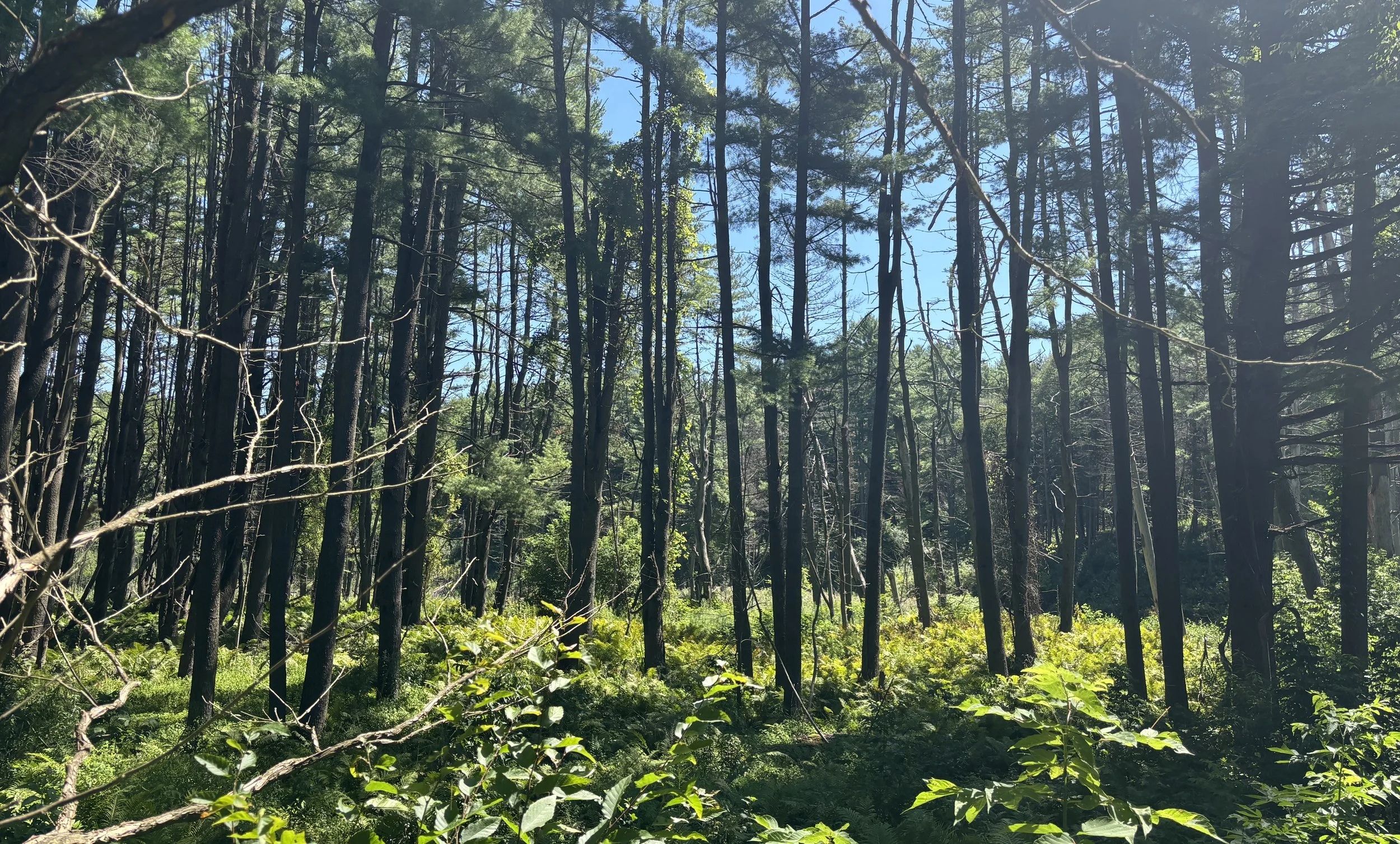
Old, towering trees stand guard on the Quechee Trail in Vermont, photographed by me. (August 2026)
At the time that I write this, I am currently in the midst of a month-long gig in White River Junction, Vermont.
Located at the border of Vermont and New Hampshire, the nature in this part of the United States mystifies me. On a day off, I cannot help but find myself on the winding trails the Upper Valley has carved into its mountains. This past Tuesday, it was the Quechee Forge in the neighboring town of Quechee, four miles west of where I am staying. Walking next to these towering trees makes me feel ancient—a creature millions of years ago walking the planet in its most primal state—or even like a frontiersman who centuries ago stood at the precipice of a new beginning.
Looking for a precipice, I soon found one, face to face for the first time in my life with a dam.
Have you ever stood in front of a dam? Seen it with your two eyes?
You think you have, for whatever reason, until you actually stand in front of this colossus with your heart almost emptied out and refilled in the next instant.

The dam at Quechee, photographed by me (August 2026).
That there is a singular feeling that I grapple with at the heels of precipices that remind me of my smallness. I am a speck, an instant, against these wooden skyscrapers, stone cascades, and the winding dirt road. One human against this planet seems to be a cosmic afterthought, or the thought that did not even make the “cut”.
Along the way, though, you must say hello.
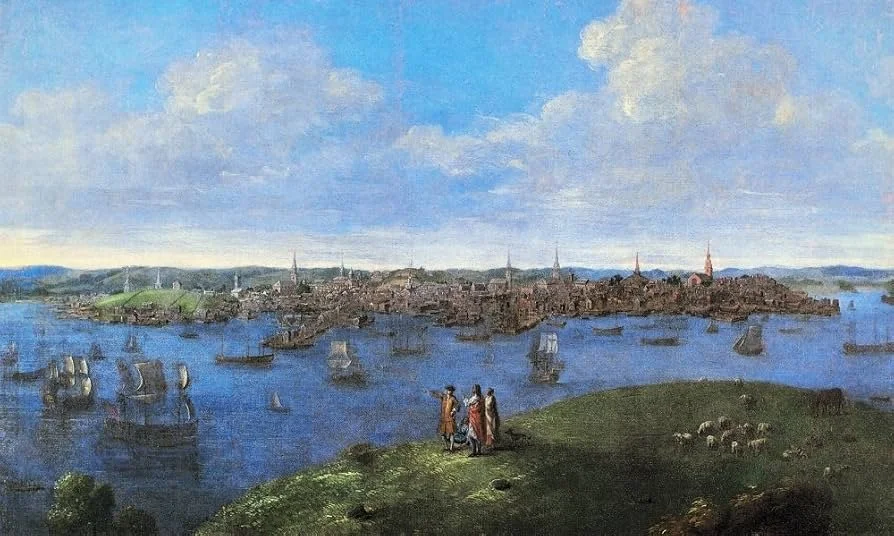
John Smibert’s “A View of Boston” (1738). Oil on Canvas.
This part of the country—New England—was uniquely positioned for a style of life that gave it an unmistakable identity and a sense of community. Being the oldest American settlement, the Winthropian “city on a hill”, this nation’s cultural history was borne out of a “village tradition” in which white colonists held “communalistic desires and individualistic actions” in dispersed but nucleated settlements (Wood 2002, pg. 52, 113). This New England village endeavors to seek “all that we love in nature, with all that we admire in humanity”, ideals that permeate the modern American imaginary to this day (Carver 1842, pg. 79; viz. Wood pg. 1–2)
This is the village.
Visitors, certain visitors, to New England may be caught by surprise by the customs of these villagers. In my New England adventures, one custom stands out to me above the rest: if you walk by a stranger, you look them in the eye and you say “Hello”. Maybe even a “how’re you doing?” But this is the norm here.
As a Northeasterner who was also raised in Texas, I was not used to this. Where I lived in Houston, even, was far removed from a Southern American identity that maybe would have normalized this custom. The impulse, the instinct even, is to bow your head and keep to yourself, moving forward and onward. If you look somebody in the eye, it ought to be timed as if it is a momentary, curious glance than an instigating gesture.
As for New England, I have been to Vermont, New Hampshire, and Maine, and have spent some time in Massachusetts as well, where locals behave this way and can attest that these interactions with strangers are perfectly normal. While this is possibly a trait rural America harbors at large, its prevalence in New England stood out to me: strangers looking other strangers in the eye and saying hello and maybe even conversing.
But who cares?
It may come as no surprise to keen observers when they see that our village is dying. The village has been dying for several hundred years and has been supplanted by metropolis and industry. In my estimation, this has slowly but surely eaten away at the mores that give all humans an inherent sense of unity.
While “introverted” cultures certainly exist worldwide, such as the Finns with their “Finnish Silence” (Fudjack 1970, 34–36), I cannot help but feel that technology, especially among youth, is exacerbating a social crisis.
To explain this, I must point out the persisting anecdotal throughline among our villagers.
When I first entered the visitor’s center and embarked on the trail, it took me about five minutes of walking for me to make my first encounter. Enter the old white man. I saw him at a healthy distance. I looked and also scanned my surroundings, hoping to get the timing right. Here he comes, he is getting closer. My eyes move from the trees to his general direction. He is looking down to watch his step. Watch out for the log. The trail winds. And now he looks in my direction. Here, we make firm eye contact. I keep my pace steady, and I smile. I nod my head as I do. He nods his head and says a brisk “hey”.
This generally kept on with folks older than me—millennials and beyond.
Enter peers. At this point, I found a spot to sit by the river while I read Salomé by Oscar Wilde. Because we were not walking, the ritual took a different shape. But as these two girls carrying Dunkin drinks on their hike—this was a truthfully humorous sight, and I do not bring it up in a disparaging boy-ish way—came down to the shore, there was nothing. We looked, they took photos of each other at one spot along the rocks, and there was silence.
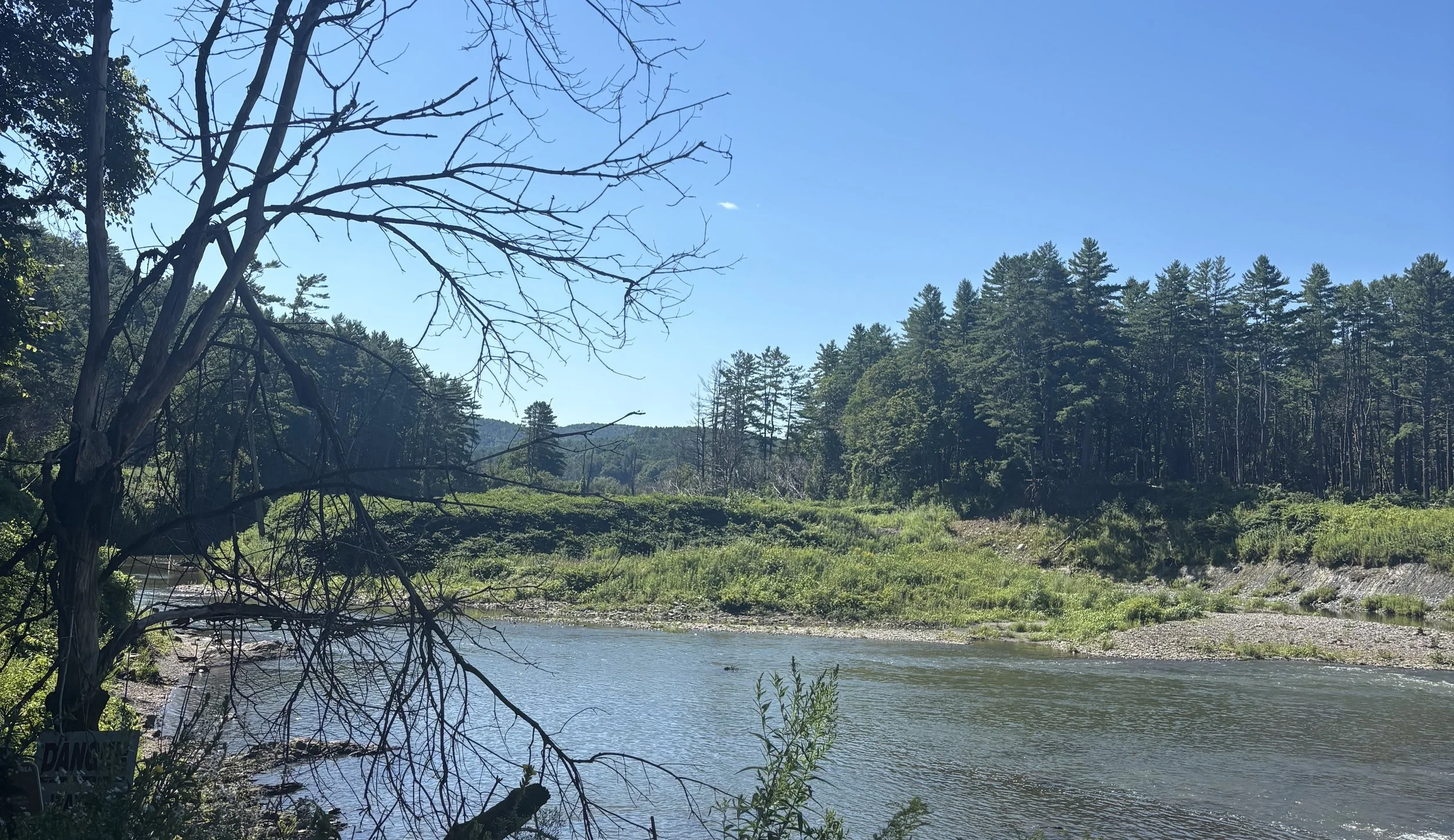
A spot along the river where I read Salomé, photographed by me (August 2026).
This is the trend everywhere I have found fellow young people in New England, on that trail and beyond. Heads bowed and onward. Silence. No eye contact or uncomfortable interactions that way. Older folks, the villagers, embraced it.
But again, who cares? And what does that have to do with the dying village?
Among these trees, readers, I discover a village far greater than any of us. When you walk through nature, you encounter a holy sanctuary that predates you by thousands and sometimes millions of years, with life—flora and fauna—speaking prayers into the winds and continuously inhabiting. I felt small.
But what I did not mention when I first brought you to the precipices that I saw was how I really met this largeness. Something about greeting strangers made the cosmic nature of this whole endeavor. Acknowledging other human beings, giving them your name, and striking up conversations you will forget make you feel like part of the community consisting of humanity. You become a steward and a lover in a deeply consequential time rather than in a statistical afterthought of a moment in time.
All this deeply charms me: New England, and how its villagers typify human endeavor and connection.
I think there is tremendous value in keeping this alive and in endeavoring to connect with strangers.
My generation—Gen Z—came of age during a dramatic historical moment when technology advanced at an exponential pace, becoming entrenched in daily life and in our identity as a species, with far-reaching social consequences. For one, the Internet has contributed to the loneliness of many young people (Smith and Alheneidi 2023). As a consequence, children and young people are losing social faculties and cultural understanding that, I believe, is detrimental to their humanity.
We do not look at strangers and say hi. We do not even acknowledge them. What is atomization, if it is not that? We are atomized, which is directly antithetical to who we have been and who we are as a species.
In addition to the humanity that is threatened by atomization, the specter of fascism looms large around our world. The rise of totalitarianism benefits from the atomization of democratic societies (Kornhauser 2017, pg. 16), and we have to act collectively to stop it.
I argue that, admittedly, as uncomfortable as it was for me, looking these people in the eyes and saying “Hello” is taking a stand for humanity and reinforcing the social bond and sense of community necessary for freedom and its preservation.
Herein lies a village, if we choose to keep it.
Visiting: A freeness to explore.
For example, I hated driving without knowing where I am going, lest I get lost. To be honest, I still somewhat dislike it. But taking mysterious new turns is okay, I am finding. Especially in an age where your phone will corral you back home. Besides, it is fun to discover new places and find roads that intersect with already familiar places.
Revisiting: My Mac’s desktop organization.
I was music-assisting a workshop back in February of this year, and on a slow day, I had an admittedly random fit of rage while looking at my desktop’s myriad folders. I understood the madness, and I knew where everything was, but it just looked ugly. So I sorted everything into one of 7 folders:
Applications
Docs
Music Copying
Music Production
Music Scores
Photos
Videos
While everything is sorted somewhere in one of those folders, there are glaring (1) file labeling issues; (2) instances of bloat; and (3) redundancies, as evidenced by having 3 separate folders relating to music.
I am only revisiting this, and soon I hope to tackle it head-on. A task for a commute/trip with Internet. (I found this out the hard way on a flight from Atlanta: you need Wi-Fi on a Mac to access/rename files because of iCloud. Ridiculous!!!)
But I look forward to the day (or a few) when I can raze my phone and computer of all bloat and organize everything. Notes app, photo albums, folders full of PDFs beware.
Bibliography
Carver, John. Sketches of New England: Or, Memories of the Country. London: Wentworth Press, 2019.
Fudjack, Sara L. “Amidst a Culture of Noise Silence Is Still Golden : A Sociocultural Historical Analysis of the Pathologization of Introversion.” Smith ScholarWorks, January 1, 1970. https://scholarworks.smith.edu/theses/581/.
Kornhauser, William. The Politics of Mass Society. London: Taylor and Francis, 2017.
Rokach, Ami. “Loneliness and Culture: A Commentary.” Archives of Psychiatry and Mental Health 8, no. 1 (May 1, 2024): 028–031. https://doi.org/10.29328/journal.apmh.1001053.
Smith, Andrew P, and Hasah Alheneidi. “The Internet and Loneliness.” AMA Journal of Ethics 25, no. 11 (November 1, 2023). https://doi.org/10.1001/amajethics.2023.833.
Wood, Joseph Sutherland, and Michael Steinitz. The New England Village. Baltimore, MD: Johns Hopkins University Press, 2002.